Is AI Using Your Website to Answer Questions About Your Business?
AI tools now describe your business from your own website, yet eight AI search tools got the facts wrong on more than 60% of queries in a 2025 study. Here is how to fix it.
Is AI Using Your Website to Answer Questions About Your Business?
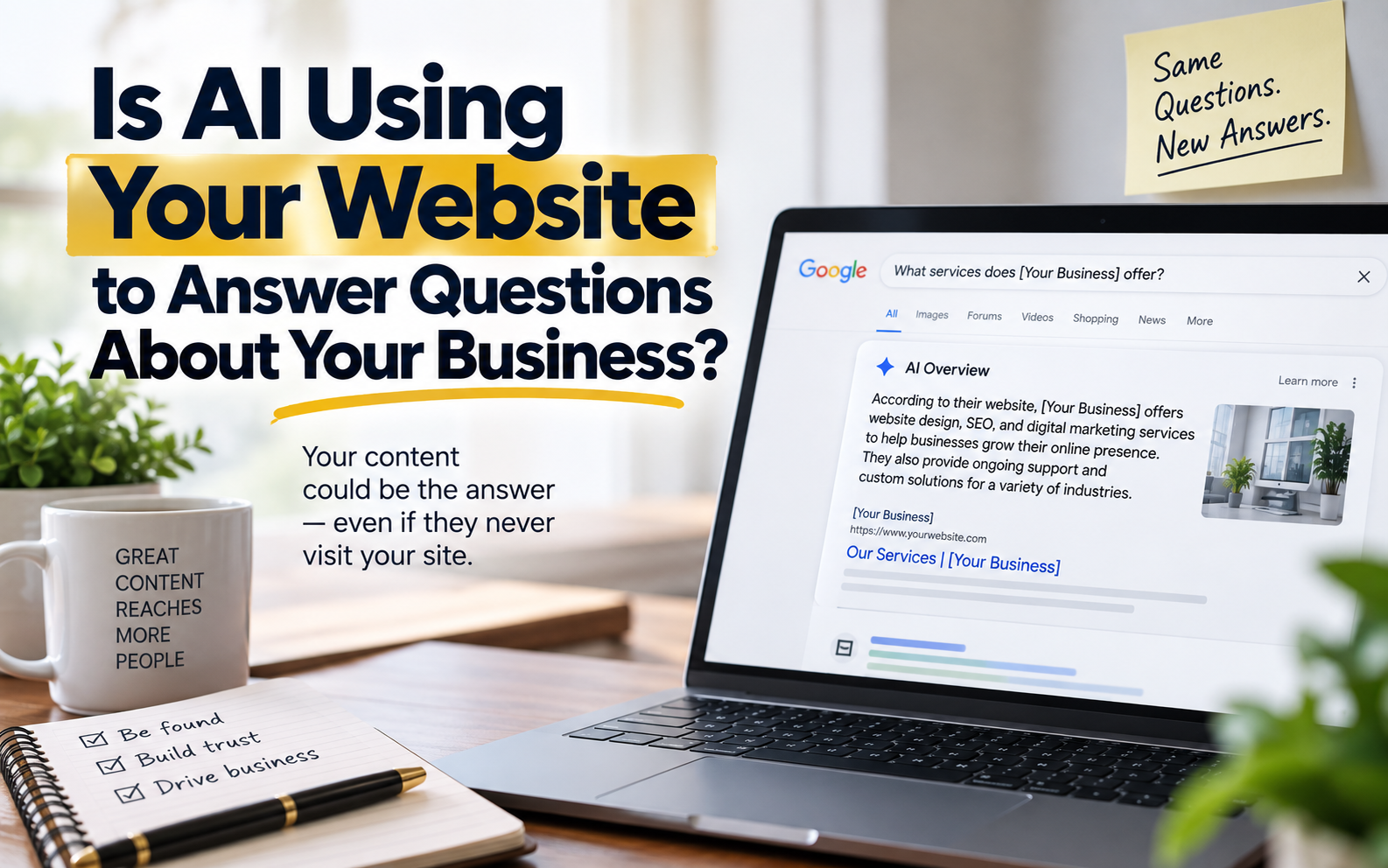
When a customer asks ChatGPT, Perplexity, or Google “what does this company do,” the answer is often stitched together from your own website. You did not write that summary. A machine did, using whatever it could read on your pages. If those pages are thin, out of date, or unclear, the AI fills the gaps on its own, and it is confident even when it is wrong. This guide explains how AI is using your website today, and what to do so it gets you right.
Key Takeaways
- In 2025, Pew Research Center found people clicked a search result on only 8% of visits when an AI summary appeared, down from 15% without one.
- Across 1,600 test queries, eight AI search tools answered more than 60% incorrectly (Tow Center, 2025), so wrong business facts are common.
- You cannot edit the AI directly. You control what it reads: your website, your structured data, and your third-party profiles.
What does it mean that AI is using your website as a source?
In 2025, Pew Research Center reported that about 18% of Google searches already showed an AI-generated summary, built by reading and summarizing web pages (Pew Research Center, “Google users are less likely to click on links when an AI summary appears in the results,” 2025). AI answer engines do the same thing. They crawl your site, pull out facts, and rewrite them into a short answer for the person asking.
So the AI is acting like a fast, literal intern. It reads your homepage, your service pages, and your reviews, then repeats what it thinks is true. It does not call you to confirm. If your site says you are open until 5 but a directory says 6, the AI picks one.
Here is the shift that matters for your business. For years, your website was a brochure people chose to visit. Now it is a data feed that machines read on your behalf and quote to buyers. The words on your pages have become the raw material for answers you never see.
Our take: Your website used to be the destination. In 2026 it is also the source code for what AI says about you, so vague copy is no longer just a weak sales pitch. It is a factual risk.
The stakes are rising fast. In July 2026, Reddit and several large publishers were reported to be weighing whether to block Google, because AI answers now use their content while sending back far fewer visitors (CNBC, “Reddit stock sinks on report it may not renew Google AI content deal,” 2026). When the biggest sites are fighting over who controls the source, small businesses cannot afford to ignore it.
How do AI answer engines decide which site to trust?
In 2025, industry analysis of tools like ChatGPT, Perplexity, and Google AI Overviews described the same basic mechanic: the model pulls candidate pages from a search index, ranks them on a trust-and-relevance score, then summarizes the strongest ones. Trust is shaped by clear content, consistent facts, and mentions on other reputable sites, not by keyword stuffing.
Think of it as a reputation check run in a fraction of a second. The AI asks a few quiet questions. Does this page answer the question directly? Do other trusted sites agree? Is the information current and specific?
Two levers move that score most. The first is your own site being clean and explicit. The second is agreement across the web, meaning your Google Business Profile, review sites, and any listing that names your business all say the same thing. When those sources conflict, the AI guesses, and a guess is where wrong answers begin.
A page that opens with a plain, direct answer, backs it with specifics, and matches what trusted directories say is far likelier to become the source an AI quotes than a page padded with marketing language. Clarity and consistency, not clever phrasing, win the citation.
For a deeper look at ranking in this new environment, see [INTERNAL-LINK: how to get found in AI search when customers ask ChatGPT, not Google -> related pillar post].
What happens when AI gets your business facts wrong?
In 2025, the Tow Center for Digital Journalism at Columbia tested eight AI search tools with 1,600 queries and found they gave incorrect answers to more than 60% of them, with Perplexity best at 37% wrong and Grok-3 worst at 94% (Tow Center, Columbia Journalism Review, “AI Search Has a Citation Problem,” 2025). These tools do not hesitate. They state wrong facts with the same confidence as right ones.
For a business, a wrong answer lands at the worst moment: when someone is deciding whether to buy. A made-up price, an old address, or a service you dropped years ago can quietly send a ready customer to a competitor. You never get the call, so you never know it happened.
The Tow Center study, which tested eight tools on 1,600 real queries in 2025, found more than 60% of answers were incorrect. That is not a rare glitch. It means you should assume some AI tool is already describing your business inaccurately, and plan for it.
Wondering whether this is really happening to you? [PERSONAL EXPERIENCE] When we audit a client’s presence, we run the same question across ChatGPT, Perplexity, Gemini, and Google AI Overviews and log every answer. It is common to find at least one tool stating a stale price or a service the client stopped offering.
For help spotting these gaps, see [INTERNAL-LINK: our checklist for auditing what AI says about your brand -> related guide].
Being the source matters even when nobody clicks
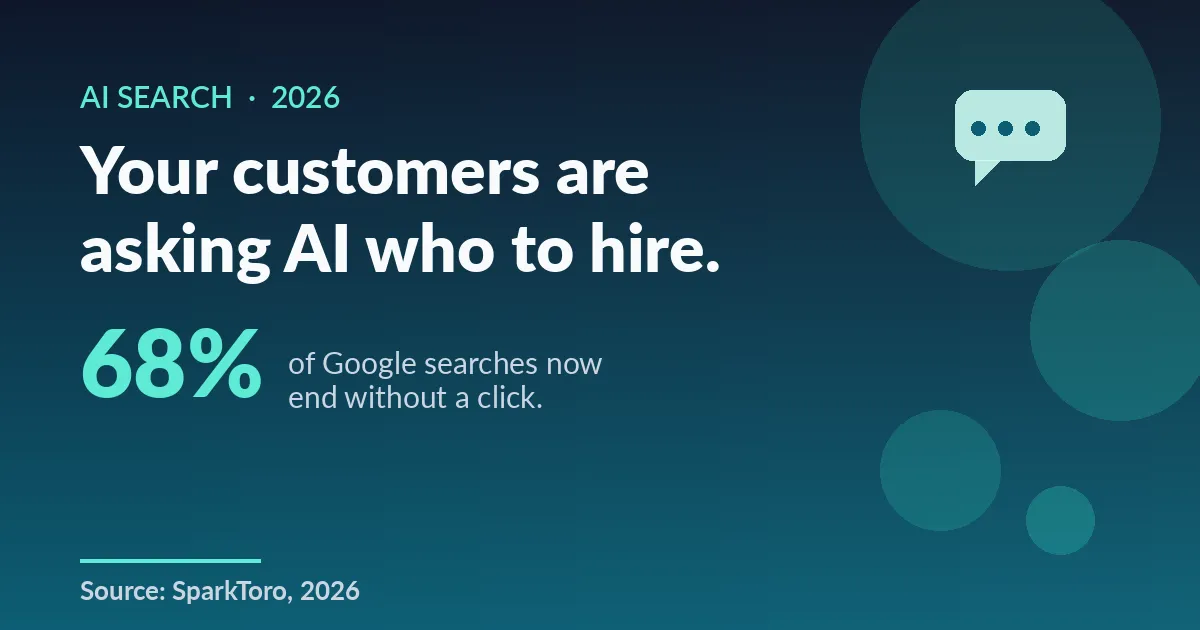
In 2025, Pew Research Center found that when an AI summary appeared, users clicked a search result on just 8% of visits versus 15% without one, and 26% ended the session entirely without clicking anywhere (Pew Research Center, 2025). Fewer people reach your site, so the summary itself, built from your pages, is doing your first impression for you.
This is the part that trips people up. It feels like the AI is stealing your traffic, and sometimes it is. But it is also introducing you to buyers who will never open your site. The summary is a handshake you do not attend, so the only way to shape it is to shape what it reads.
The click numbers back this up. In 2025, Pew Research Center measured that only 1% of visits led to a click on a link inside the AI summary itself, so most people read the answer and move on. Being the accurate source is now the whole job, because the summary, not your landing page, is what most people see first.
Other measurements point the same way. In 2025, Ahrefs studied 300,000 keywords and found that the top organic result had a 34.5% lower click-through rate when a Google AI Overview was present (Ahrefs, “AI Overviews Reduce Clicks by 34.5%,” 2025). In the same year, Digital Content Next reported a median 10% drop in Google referral traffic across member publishers, with some losing up to a quarter (Digiday, “Google AI Overviews linked to 25% drop in publisher referral traffic,” 2025). The pattern is steady, not a blip.
That reframes the goal. The old question was “how do I get more clicks.” The new question is “when the AI answers for me, is the answer correct and does it sound like a business worth choosing.” If yes, you win even when nobody clicks.
Is AI search really big enough to worry about?
In 2025, Similarweb reported that AI platforms drove more than 1.13 billion referral visits in June, up 357% year over year, with referrals to news and media sites up 770% (Similarweb, “AI Referral Traffic Winners By Industry,” 2025). The base was small a year earlier, so the percentages look wild, but the direction is clear and steep.
Retail shows the same pattern. In early 2025, Adobe Analytics reported that traffic to U.S. retail sites from generative AI sources jumped 1,200% versus the prior summer, as shoppers started asking AI tools what to buy. People are not just researching. They are using these answers to make decisions.
And it is spreading to buying queries specifically. In 2026, Semrush studied more than 600,000 keywords and found the share of commercial searches showing a Google AI Overview grew 71% in six months (Semrush, “AI Overviews are expanding across commercial intent search,” 2026). So AI now answers the very searches that lead to sales.
You do not need these tools to replace Google to feel the effect. You only need enough of your future customers to ask an AI about your category, which, based on 2025 and 2026 data from Similarweb, Adobe, and Semrush, is already happening.
How do you make your website the source AI reads correctly?
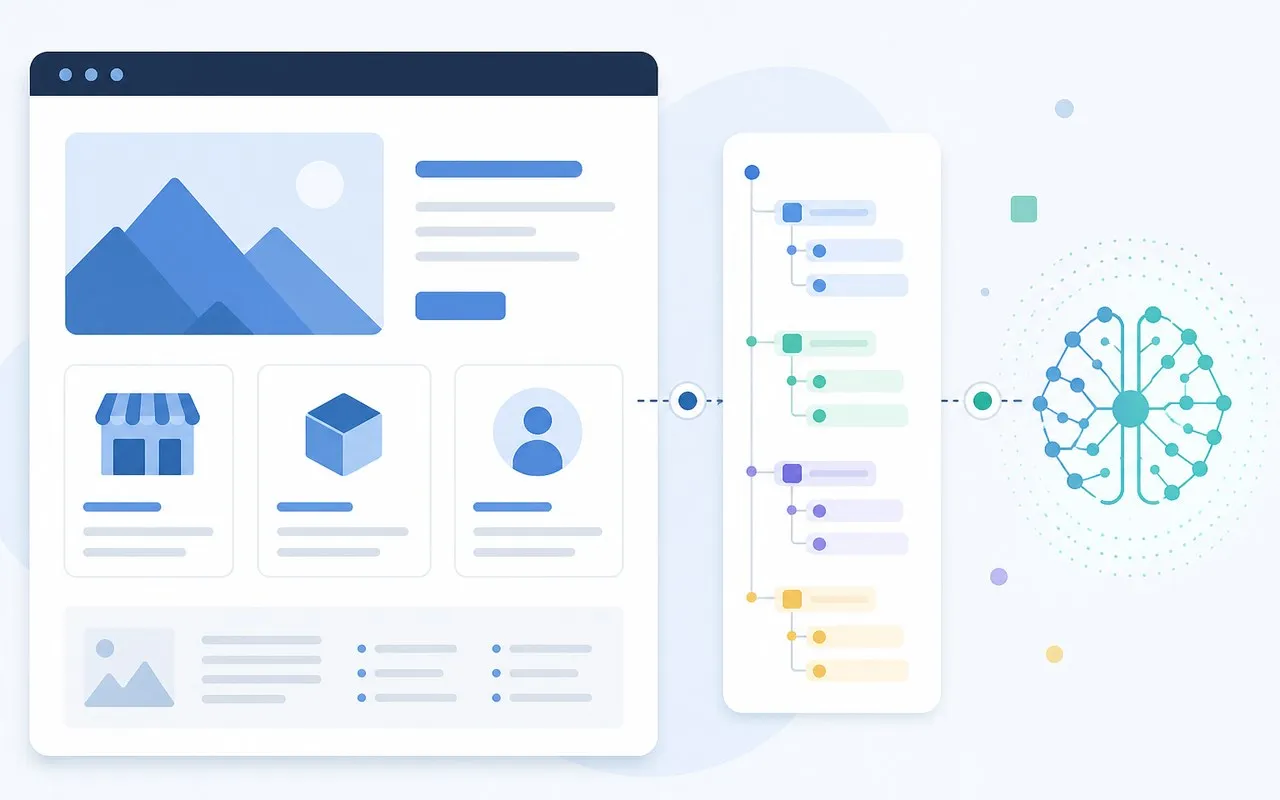
The fix is not to trick the AI. It is to feed it clean, consistent facts so it has nothing to guess about. Because you cannot edit the model, you edit every source it reads, starting with your own site. In 2025, practitioner guidance converged on a clear sequence: fix structured data first, then rewrite your pages for direct answers, then keep your outside profiles in sync.
Here is a practical order of work you can follow.
- Add structured data (schema). This is machine-readable labeling that tells AI your name, address, hours, services, and prices as facts, not guesses. Organization and LocalBusiness markup are the priority.
- Rewrite your key pages to answer first. Open each important section with a plain, 40 to 60 word answer to the question a customer would ask. AI tools extract these direct answers cleanly.
- Fix your outside profiles. Make your Google Business Profile, review sites, and directory listings all state the same hours, address, and services. Models weight these as trusted confirmation.
- Keep it current. Update pages when anything changes, since stale facts are a top cause of wrong AI answers.
Our finding: In client audits, the single most common trigger for a wrong AI answer is a mismatch between the website and the Google Business Profile. Aligning those two sources fixes more errors than any other single step.
Structured data quietly does the heavy lifting here. A LocalBusiness schema block that states your hours, address, and services in machine-readable form gives AI explicit facts to quote instead of guesses to invent, which is why practitioner guidance in 2025 put schema first in the sequence.
For the step-by-step version, see [INTERNAL-LINK: our guide to structured data for small business websites -> related how-to post].
Where to start this month
The honest answer is that there is no magic switch, and anyone selling you one is guessing. In 2025, named search practitioners warned that quick-fix “AI hacks” do not work and that the field is filling with spam. Steady, boring correctness beats clever tricks.
Start small and specific. Run your top three customer questions through ChatGPT, Perplexity, and Google, and write down what they say about you. Where an answer is wrong, trace it to the source, your site or a profile, and correct that source. Re-check in a few weeks.
This is exactly the kind of unglamorous, ongoing work that we handle for clients at Rumeira, so you can spend your time running the business rather than fact-checking chatbots. Whether you do it yourself or hand it off, the goal is the same: make your own information the cleanest, most consistent version available.
Ready to see what AI says about you right now? [INTERNAL-LINK: request an AI visibility audit -> contact or services page].
Frequently Asked Questions
Can I stop AI from using my website?
You can block some AI crawlers, but it usually backfires. In 2025, Pew Research Center measured that roughly 18% of Google searches already show AI summaries, so blocking often removes you from answers your competitors still appear in. Controlling the facts beats hiding from them.
How do I fix a wrong fact an AI says about my business?
You cannot edit the AI directly. Correct the sources it reads, meaning your website, your Google Business Profile, and review sites, so they all agree. Models pick up the corrected facts on their next crawl, which can take days to weeks depending on the tool.
Does structured data really help AI understand my site?
Yes. Structured data, also called schema, labels your facts in a form machines read directly. In 2025, practitioner guidance consistently ranked Organization and LocalBusiness schema as the first step, because it gives AI explicit answers instead of leaving your hours, address, and services to guesswork.
Is this different from normal SEO?
It overlaps heavily. The same clarity, accuracy, and trust signals that help you rank on Google also help AI cite you. In 2026, Semrush found AI Overviews expanding fast into commercial searches, so treating AI visibility and search visibility as one job is the practical approach.
The bottom line
AI is already reading your website and answering for you, whether or not you have opted in. The data from 2025 and 2026 is consistent: fewer clicks, more AI summaries, and a real risk of wrong facts reaching buyers at the moment they decide. In a 2025 Tow Center study, tools were wrong more than 60% of the time, so silence is not safe.
The good news is that the fix is within your control. Make your website clear and current, add structured data, and keep your outside profiles in sync. Do that, and the machine reading your business has nothing left to guess.
For your next step, see [INTERNAL-LINK: how to get found in AI search -> related pillar post].
About the author
This guide was written by the Rumeira team, a Marketing and Software studio that helps local and small businesses show up correctly across search and AI answer tools. We run hands-on audits of what ChatGPT, Perplexity, Gemini, and Google AI Overviews say about our clients, then fix the sources those tools read: websites, structured data, and business profiles. Questions about your own AI visibility? Reach us at rumeira.com.
Sources
- Pew Research Center, “Google users are less likely to click on links when an AI summary appears in the results,” 2025-07-22, retrieved 2026-07-26, https://www.pewresearch.org/short-reads/2025/07/22/google-users-are-less-likely-to-click-on-links-when-an-ai-summary-appears-in-the-results/
- Tow Center for Digital Journalism, Columbia Journalism Review, “AI Search Has a Citation Problem,” 2025-03-06, retrieved 2026-07-26, https://www.cjr.org/tow_center/we-compared-eight-ai-search-engines-theyre-all-bad-at-citing-news.php
- Ahrefs, “AI Overviews Reduce Clicks by 34.5%,” 2025-04-17, retrieved 2026-07-26, https://ahrefs.com/blog/ai-overviews-reduce-clicks/
- Similarweb, “AI Referral Traffic Winners By Industry,” 2025, retrieved 2026-07-26, https://www.similarweb.com/blog/insights/ai-news/ai-referral-traffic-winners/
- Adobe, “Adobe Analytics: Traffic to U.S. retail websites from Generative AI sources jumps 1,200 percent,” 2025-03-17, retrieved 2026-07-26, https://blog.adobe.com/en/publish/2025/03/17/adobe-analytics-traffic-to-us-retail-websites-from-generative-ai-sources-jumps-1200-percent
- Semrush, “AI Overviews are expanding across commercial intent search [Study],” 2026-07-02, retrieved 2026-07-26, https://www.semrush.com/blog/ai-overviews-commercial-search-study/
- Digiday, “Google AI Overviews linked to 25% drop in publisher referral traffic, new data shows,” 2025, retrieved 2026-07-26, https://digiday.com/media/google-ai-overviews-linked-to-25-drop-in-publisher-referral-traffic-new-data-shows/
- CNBC, “Reddit stock sinks on report it may not renew Google AI content deal,” 2026-07-22, retrieved 2026-07-26, https://www.cnbc.com/2026/07/22/reddit-stock-google-ai-content-deal.html